Finalist
Breaking the Cycle
By Johnson & Johnson Supported by Avalere Health
Summary of work
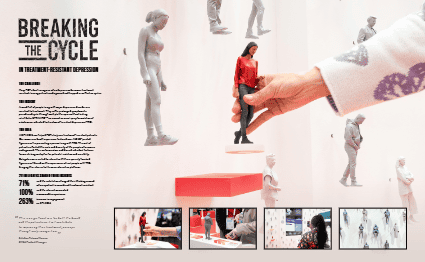
More than one in two patients with depression may be living with treatment-resistant depression (TRD), yet many cycle through ineffective treatments before being recognised and considered for appropriate care.Our insight revealed that the challenge was not simply HCP awareness, but behaviour: psychiatrists needed to recognise eligible patients sooner and overcome perceived barriers to treatment initiation.From the outset, we designed an integrated HCP education journey to address these sequential barriers, moving psychiatrists from recognition towards action. Targeted communications first primed earlier recognition. At EPA 2025, Breaking the Cycle made overlooked patients impossible to ignore. More than 150 patient figures made TRD tangible, while an interactive experience challenged psychiatrists to reconsider when depression becomes treatment resistant.The journey then progressed at ECNP to the next planned behavioural focus: reducing perceived complexity around initiation. Informed by learnings from EPA, “A chair is all you need” reframed administration around practical achievability.Across pre-congress priming, immersive education and field follow-up, each intervention played a deliberate role in helping HCPs identify TRD sooner and feel more confident taking the next step towards appropriate care.
Judges' comments
This was a strong, insight-driven programme that clearly identified the key barriers through research and used these to shape a focused and well-targeted strategy. The objectives were well defined and aligned to the critical stages of behaviour change, with an emphasis on sustaining engagement beyond the initial intervention. A particular strength was the carefully designed participant experience, with tailored activities before, during and after the congress, creating a coherent journey rather than a single event. The programme was supported by meaningful success measures and demonstrated encouraging evidence of longer-term impact, showing that the activations extended beyond immediate engagement to influence ongoing behaviours and outcomes.